Beauty Founders On Building Brands And Navigating Motherhood
Inside The Work: Danessa Myricks, Janell Stephens And Ashunta Sheriff On Building Brands And Navigating Motherhood
- Danessa Myricks overcame industry exclusion to build a brand reflecting her authentic self, empowering customers through openness.
- Janell Stephens grew Camille Rose from a personal need into a lifestyle brand centered on wellness and education for her community.
- Ashunta Sheriff preserves Black beauty history through her brand and platform, committed to documenting cultural contributions.
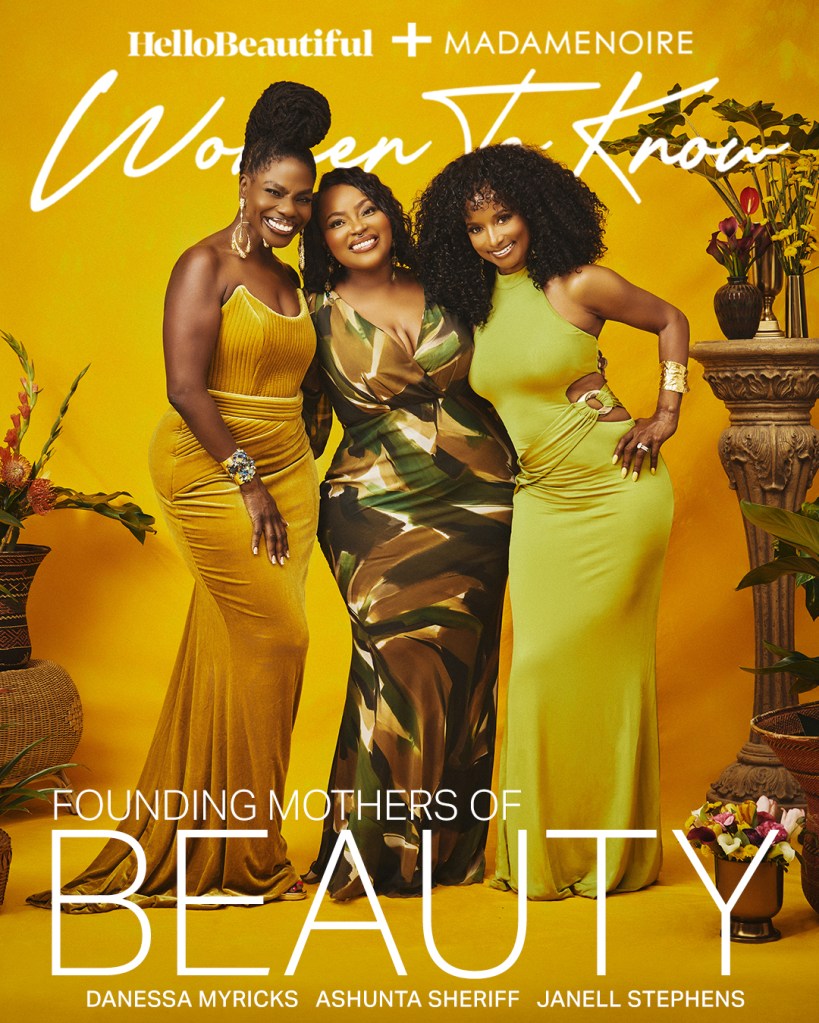
After months of cold weather, it’s the first really nice day in NYC. The kind that brings out short shorts and flowy dresses and reunites your skin with a kiss from the sun. Inside a studio in Chelsea, that warmth carries through the room.
At first glance, it may seem like a typical cover shoot. It isn’t. The women at the center of it are usually the ones preparing others for the spotlight—shaping faces, building looks, and working just out of frame. Today, they’re the ones in front of the camera, a position each of them has had to grow into.
Danessa Myricks, Janell Stephens, and Ashunta Sheriff all arrive with their own glam teams—though Danessa and Ashunta do their own makeup. “I know my face best,” Myricks says with a bright, easy confidence, Sheriff nodding in agreement. Across the room, Janell tracks the movement with a quiet focus as her hairstylist finishes pinning her curls into place.
On the table is a scattering of Danessa’s Universal Blurring Balms. The makeup artist assigned to my face already has a full-size in her kit—a quiet signal of her reach. I lean toward Ashunta to tell her how much I love her UV Vegan Mascara—“a must-have for festival season,” I say. She smiles. Her approach to beauty is expressive but grounded—high pigment, high impact, but always designed to work across real skin.
Later, I open Instagram and see Kim Kardashian styling her daughter, Chicago’s hair using Camille Rose’s Curl Love Moisture Milk and Curl Maker. Soft, defined curls are pulled into a half-up, half-down style. Kim mentions it’s one of her favorite parts of the morning before school. It’s a reminder that what Janell built at home for her own children now lives far beyond it.
Set Life
The set leans into a modern-day Mother Earth with golden tones and lush greenery for a rooted yet elevated vibe. Though Danessa and Ashunta both have makeup brands, their dynamic reads less competitive and more familial. Ashunta later tells me she reaches out to Danessa for advice. “Unlike the hair girls—or so I hear,” she jokes, glancing toward Janell.
“Who???” Janell shoots back, without missing a beat. “Not me. I’m cool with everyone.” By the end of the day, Danessa and Janell had decided to figure out how to partner with one another.
They’re connected beyond their founder status, threaded through what they’ve each chosen to build and why. None of them entered the beauty industry feeling fully seen. So, they built what they couldn’t find. It began as personal solutions—products made at home, artistry developed behind the scenes, stories shaped outside the spotlight—has grown into something larger. What began as personal solutions—products made at home, artistry developed behind the scenes, stories shaped outside the spotlight—has grown into something larger. Each of them created from a place of absence, then expanded that work into something that reaches far beyond them. Their brands function as ecosystems, rooted in community, informed by motherhood, and designed to hold more than just a product. Each of them arrived here differently, shaped by distinct experiences, decisions, and risks—but the through line is clear in how they chose to build.
Danessa Myricks’ Yummy Skin

Danessa Myricks didn’t set out to be the face of anything. For years, she was most comfortable behind the scenes. Her brand has been around since 2000, originally known as I Make You Beautiful. At the time, she kept herself at a distance from it, focused on creating rather than being seen. It wasn’t accidental. “It was hard to love the beauty industry because it wasn’t loving me,” she says. For much of her life, she didn’t see herself reflected in the spaces she’s currently helping to redefine. “I didn’t see people who looked like me—my mom, my grandmother,” she adds. Over time, that absence shaped how she saw herself, reinforcing the idea that she needed to be someone else to be considered beautiful.
In 2016, she made a decision that would change both the brand and her relationship to it. She put her name on it. Danessa Myricks Beauty evolved from a product line to a reflection of her. “The business started growing when I started healing,” she says, adding, “I realized I needed to work on myself from the inside out.” What followed wasn’t immediate ease, but exposure.
On set, that tension is still visible. She’s more comfortable shaping the image than inhabiting it. At one point, I guide her through a pose, adjusting her angle, asking her to hold a moment a beat longer. Having spent years in front of the camera myself, I recognize it immediately. Myricks is used to directing, to controlling every frame. Now, she’s the subject.
The room falls away for a moment. She’s locked in on what I’m saying, following each adjustment closely. She admits it doesn’t come naturally. She’s learning to step into the light.
At the start of that shift, she began documenting that process—on camera, in real time, and using the products on herself. Appearing on camera without makeup for the first time was, in her words, “one of the most horrifying things I’ve ever done.” It was also freeing.
“Once I opened up, I just never closed it back,” she says. That openness has changed how people connected to her company. Her personal platform has grown to more than 1.1 million followers, outpacing the brand itself. It’s a reflection of something deeper than product performance. People aren’t just buying into the formulas; they’re responding to her.
For Myricks, that distinction matters. “We’re changing how people feel about themselves,” she says. What she’s built is as much about emotional resonance as it is innovation, shaped in constant dialogue with the community that pushed her to be seen in the first place.
“As I grow, everything else grows,” she says. That expansion is intentional. “I wanted to be an example of what people can see that they can be.” It shows up in how she operates. Among beauty editors, she’s often described as a founder who is as approachable as she is visionary. Among customers, she’s known for responding to comments, educating in real time, and creating a space where people feel considered. “The core of the brand is freedom,” she says.
Camille Rose’s Mission
In front of the camera, Janell Stephens moves with a steady, contained energy. She doesn’t need to fill the room to command it. There’s a calm precision to how she carries herself, the kind that reads serious at first glance. That restraint makes sense when you understand how she got here. “I didn’t set out to be in beauty,” she tells me later. “I just wanted to solve a problem for my children.”
She didn’t come into the industry chasing visibility. The focus was always the work itself, which still comes through in how she carries herself now. Later, during the roundtable, she laughs at the perception that she’s reserved. It’s one of the biggest misconceptions about her, she says. She’s actually the opposite. Silly, even.
At one point, she steps away to take a FaceTime call. On the other end is Kim Kardashian. The exchange is quick, familiar, and feels like part of the rhythm of her day. When she returns, she settles back into place without disruption, as if nothing has shifted at all. The ease of it all speaks to something deeper than access. She’s built something that moves with her.
What started as a personal pursuit—formulating products with better ingredients for her family—quickly became something more. “Out of that obsession and passion, it turned into a business,” she says. Her entry into beauty wasn’t about chasing the industry. It was about responding to a need she saw up close, then expanding that solution beyond her home.
From the beginning, Stephens was thinking beyond a single category. “It’s not just a hairstyle—it’s a lifestyle,” she says. That philosophy is evident in how she approaches her work, with an emphasis on wellness, education, and intention. “I wanted to educate our community on making healthier choices,” she explains. “We deserve the best.”
She built Camille Rose on her own terms, growing it in a way that felt sustainable. “I was okay with growing at a pace that was comfortable for me,” she says. For Janell, there’s no urgency to compete, only to build products that work. “I didn’t compete with anyone,” she says, reflecting on where she is now. “I just enjoyed it.”
That perspective extends to how she leads. “Women, especially mothers, are natural leaders,” she says. For Stephens, leadership is grounded in care and consistency. It’s visible in how she moves, how she builds, and how she holds space for the people her brand serves. That sense of community extends beyond the brand itself, through initiatives like her foundation and Beauté Noir Fest, which center and support women and families in tangible ways.
Across the room, my focus turns.
Ashunta Sheriff steps into a gold Hervé Léger dress, the fringe catching the light with every movement. It sways as she turns, glinting under the studio lights. For a moment, she looks like an Emmy brought to life—fitting for a two-time nominee. She’s petite, but her presence lands immediately. Warm, animated, and fully engaged, she has the confidence of experience and the energy of something new.
The Evolution Of Ashunta Sheriff Beauty
Despite a career that spans more than three decades, Sheriff is in a new era. Ashunta Sheriff Beauty, her namesake brand, is still relatively young, just a few years in. And while her resume could carry her, she’s approaching this chapter from the ground up, learning, adjusting, and even using AI to help power her business forward.
When she speaks, it’s with the conviction of someone who knows exactly where she stands. Sheriff has worked with some of the biggest names in entertainment, but she isn’t interested in listing credits. She’s interested in context.
“I’m here to be the historian,” she says. That role feels especially urgent now, as trends rooted in Black beauty continue to circulate faster than the stories behind them. “I need Black women to really see the contribution they make to beauty.”
That perspective also informs how she’s thinking beyond product. Through Hip-Hop Beauty, the arts and cultural platform she co-founded, Sheriff is working to document the influence of Black beauty within a broader cultural framework. It’s the same idea, expressed at a different scale.
As a cultural anthropology major at Howard University, Sheriff was already drawn to the ways women shape and carry culture. As a makeup artist, she watched those ideas become global. Dark lip liner, cornrows, high blush, door knockers, sculptural nails—beauty codes that Black women created and refined—have traveled everywhere, often without credit. “I think we do ourselves a grave disservice when we don’t remember our past,” she says. “History will be rewritten if we don’t write our own.”
There’s a sense of responsibility in her words. She understands both the scale of her contribution and the gaps that still exist. For Sheriff, creation isn’t enough. It has to be remembered. She’s preserving a point of view as much as she’s building a brand.
The reality behind what each founder has built is concrete. There were moments where the stakes were immediate. Myricks recalls preparing to give a keynote, and moments before going on stage, she received a call that her home was at risk of foreclosure. The work didn’t pause. It couldn’t. For all three women, building meant pressing forward, even when the outcome was uncertain.
For all that connects them, motherhood shows up differently within each of them. Stephens speaks about it with certainty. “There was no mom guilt for me,” she says. Building Camille Rose felt aligned with how she was already showing up for her children. She mentions cooking for them every day, a detail that catches the room off guard. Sheriff’s experience has been more complicated. “As a founder, my brain is always on,” she says. She’s had to reckon with what the work requires. “Your kids get a little bit put aside,” she admits. “You have to take accountability for that.” For Myricks, motherhood was the catalyst. She started her brand with a newborn daughter and a young son, navigating uncertainty in real time. “It was super scary,” she says, adding, “feel the fear and do it anyway.” That fear sharpened her sense of purpose. “When you bring children into the world, all they see is you,” she says. “I wanted them to be able to see their possibility through me.”
There’s no single way to hold the title of founder and mother. What it requires is constant negotiation. Building at this level asks for time, energy, and a constant mental presence. But it also creates something that extends beyond them. Their brands aren’t just products or businesses. They reflect lived experience, hold community, and make space for people who weren’t always considered in the first place.
The day began with a group shot. All three women step in together, falling into place with an ease that doesn’t need direction. The music moves from Whitney to Cheryl Lynn, a playlist that carries across generations. They laugh between frames, adjusting, stepping in and out without hesitation. No one is trying to outshine anyone else. There’s no visible hierarchy, just a rhythm they all seem to understand.
By the end of the day, they’re seated for a moderated panel, reflecting on the work that brought them here. The conversation carries the same tone as the shoot. Thoughtful, direct, and grounded in experience.
A toast follows. I reach for champagne. They reach for water.
It’s a small detail, but it lingers. After hours of shooting, speaking, and showing up, there’s still a sense of discipline and self-care. It doesn’t feel like a performance. It’s part of how they work. For them, this is how it’s built: day by day, decision by decision, over time.
Women To Know Roundtable Credits:
iONE Digital
Tanya Hoffler-Moore VP,VIDEO
Cliché Wynter-Mayo Executive Producer
Danielle James Moderator & Cover Story
Jose Torres Senior Producer
Jake Edwards Director of Video Development
Naima Simmons Director, Production
Augustus Cook II Senior Manager, Video Engagement & Growth
Leo Demirjian Video Ops/QA Manager
Fluid Underbelly Productions
Phakiso “Kiki” Collins Director & Executive Producer
LaVarro Jones Coordinating Producer & Editor
Curts A. D’amour Director of Photography
Goldie E. Patrick Set Design
Brittany Chanel Jackson Producer
Joseph Williams BTS Video