The Difference Between Perms, Relaxers, and Texturizers
Perm, Relaxer, Or Texturizer? What to Know Before Your Next Chemical Treatment
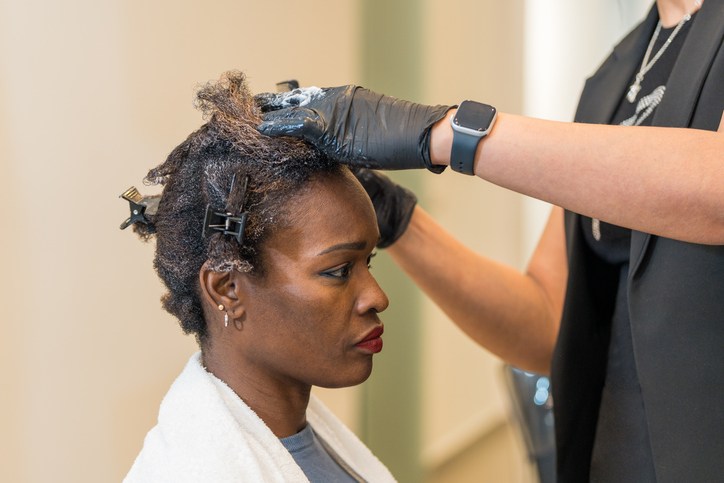
As the conversation around Black hair becomes more nuanced, many people are standing firm on how they wear their hair. Some folks are devoted to the natural hair movement, while others have forged a new path with chemical treatments. Although the world of chemical hair treatments is broad, three terms frequently come up in conversations about Black hair: perms, relaxers, and texturizers. And since these terms are often used interchangeably, it’s easy for confusion to grow when it’s time to sit in the salon chair.
What is a perm, relaxer, and texturizer?
Simply put, a relaxer is a chemical treatment that permanently straightens the hair by altering its natural curl pattern. The processing time varies depending on the product, hair texture, and manufacturer’s instructions. A texturizer works similarly to a relaxer but is generally used to loosen the hair’s curl pattern rather than fully straighten it. While texturizers are often described as a milder form of a relaxer, they can be an option for people with coily and kinky textures who want to loosen their curl pattern while maintaining some of their natural texture.
On the flip side, a perm—not to be confused with a relaxer—is a chemical treatment designed to create curls or waves. The hair is wrapped around rods or rollers, and a neutralizer is applied to help set the newly formed shape. Depending on the desired result, perms can create everything from tight, springy curls to soft, beachy waves.
Although the idea of a chemical treatment may seem tempting to some, it’s not something to jump into. “The biggest thing to understand is that all three permanently alter the treated portion of the hair,” celebrity hairstylist Kee Taylor tells HelloBeautiful. “That’s why consultation, proper application, and maintenance are so important; you can’t simply wash the treatment out and expect your original texture to return.”
Chemical treatments in Black hair
Aside from the belief that chemical treatments can make Black hair more manageable, there’s more to consider before making the switch. “Curl pattern, strand thickness, density, porosity, and the hair’s overall condition all need to be considered before applying any chemical treatment,” Kee says. “Someone with fine, fragile strands may require a very different approach than someone with dense, coarse hair, even if they have a similar curl pattern.”
Kee notes that many people believe that a texturizer is damage-free and not a “real chemical treatment” since it doesn’t straighten the hair completely. However, the treatment changes the hair’s structure (like any other chemical treatment), which makes the hair more susceptible to damage.
While some people are still guilty of putting Black hair in a box, navigating chemical treatments is not a one-size-fits-all approach. “Healthy chemical services are about proper assessment, timing, and technique–not trying to achieve the straightest or loosest result possible,” Kee says.
Think about how chemical treatments can fit into your lifestyle.
Opting for a chemical hair treatment means taking your lifestyle and long-term goals into account. Kee encourages people to ask themselves how much of a change they actually want and how much maintenance they can realistically commit to. Failing to keep up with treatments can lead to locking, matting, and tangling as new growth comes in. Meanwhile, overprocessing can contribute to excessive dryness, breakage, and hair loss.
“Chemical services shouldn’t be a trend-driven decision—they should work with your hair goals and the level of maintenance you’re comfortable with,” Kee says.
Maintenance between chemical treatments is essential to hair health.
Your hairstylist is not the end-all, be-all of hair maintenance post-treatment. Since chemically treated hair can be more vulnerable to damage, Kee shares that the focus should be on keeping hair moisturized and minimizing additional stress from overmanipulation and excessive heat. For those working with a curly or wavy texture post-perm or texturizer, using products that help maintain your texture is key. For example, the Love Ur Curls Curl Defining Lotion is great for creating soft definition. If you’re looking for more body, the Love Ur Curls Volumizing Foam adds a lightweight lift and shape to your hair.


For post-relaxer maintenance, a well-balanced routine can help keep the hair hydrated and strong, including regular deep conditioning and protein treatments when appropriate. That said, if you’re considering a perm, relaxer, or texturizer for the first time, it’s essential to consult with a licensed hairstylist.
“Be honest about your hair history, your current routine, and what you’re hoping to achieve,” Kee says. “The best chemical service is one that’s customized to your individual hair and lifestyle, not simply the strongest formula or the most dramatic transformation.”
- Morris Chestnut Dishes On His ‘Watson’ Press Tour Fashion And Playing A ‘Doctective’ In The New Medical Drama
- Sis, That Blue Light Is Aging You. Here Are 5 Tinted Sunscreens You Need To Combat It
- ‘Grotesquerie’ Star Raven Goodwin Portrays The Scary Truth About Eating Disorders Through Her Character Merritt